
The Gambia looks easy to navigate on a map. The country is narrow, the main tourism areas sit close together on the Atlantic coast, and a single river defines much of its geography. Then a first-time visitor tries to move from Banjul International Airport to a hotel, cross from Banjul to Barra, visit family in the North Bank Region and reach an upcountry town on the same trip. Suddenly the map has opinions.
Getting around The Gambia is not difficult, but the best transport depends on distance, time of day, luggage, weather and how much uncertainty you are comfortable with. A hotel transfer that feels expensive to a backpacker can be excellent value to a family landing after midnight. A ferry that is convenient for a foot passenger may be less attractive for a driver facing a long vehicle queue.
This guide focuses on practical choices rather than pretending there is one correct way to travel.
Arriving at Banjul International Airport
Banjul International Airport (BJL) is at Yundum, east of the coastal resort areas and Banjul. Most international visitors continue by taxi, pre-arranged private transfer, hotel shuttle or tour-operator coach.
The simplest option is a pre-arranged hotel or private transfer. Someone meets the flight, the destination is already agreed and there is no negotiation with luggage in hand. This is especially useful for late arrivals, families, first-time visitors and travellers carrying expensive equipment.
Taxis are available for scheduled arrivals. Online airport guidance says the main destinations have established fares or posted guidance, while journeys outside common routes may require negotiation. Because transport prices change, do not treat an old blog or screenshot as a tariff. Confirm the destination and total price before getting into the vehicle, and ask whether the quoted amount is per vehicle or per person.
Shared transport can be cheaper, but it is less convenient with suitcases and may require walking or transferring to another vehicle. It also becomes less attractive late at night when services thin out. Saving money is useful; standing on Yundum Road at midnight conducting an ethnographic study of minibus availability is less useful.
Airport transfer checklist
Before landing, save the accommodation’s phone number and exact location in your phone. “Senegambia” can describe an area, not a particular hotel entrance. If a driver is meeting you, get the name and phone number in advance.
Keep enough Gambian dalasi or an agreed payment method available for transport. If paying in another currency, establish the exchange basis before the journey. Do not assume the driver can process a card.
If you arrive during a power or mobile-data disruption, screenshots of the hotel address and booking details can be more dependable than an app that suddenly decides the map is a philosophical concept.
Taxis around the coastal areas
Taxis are the most flexible day-to-day option around Banjul, Bakau, Fajara, Kotu, Kololi, Bijilo and the wider Greater Banjul Area. Some journeys operate on shared routes while others are private hires. Ask before departure if you are unsure which arrangement you are entering.
For a private trip, agree the fare first. This is especially important for airport journeys, late-night travel, waiting time and trips outside normal routes. Hotels and restaurants can often help arrange a driver, which may cost more than bargaining directly but gives the traveller a clear contact point if plans change.
UK travel advice warns that some local taxis are not roadworthy. Check basic conditions before a long journey: tyres, seat belts where fitted, lights for night travel and whether the driver appears rested and sober. If the vehicle feels unsafe, choose another one. Politeness does not require completing a journey in a car you do not trust.
Shared taxis and minibuses
Shared taxis and minibuses are part of everyday Gambian transport and can be dramatically cheaper than private tourist transfers. They work best for travellers with light luggage, time and enough local knowledge to understand where routes start and end.
The trade-off is predictability. A shared vehicle may wait for passengers, stop repeatedly and require a change before the final destination. Route information is often understood locally rather than presented through the kind of formal timetable visitors expect.
Ask your hotel, host or a trusted local contact where to board and what the normal fare is before starting. Carry small denominations. If you are unfamiliar with an area, make the first journey in daylight so landmarks and transfer points are easier to understand.
Driving and hiring a car
Hiring a car gives enormous flexibility if you plan repeated family visits, business appointments or travel outside the tourism strip. It also transfers responsibility for road conditions, navigation and checkpoints directly to you.
The Gambia drives on the right. Major roads have improved, but UK travel advice still warns of severely potholed roads in some areas, poor lighting after dark and weak vehicle lighting. Road conditions can deteriorate quickly off the main routes.
If you are visiting for a short period, check the current rules for using your home licence or an international driving permit with the rental company and relevant authorities. UK guidance says residents staying beyond three months must apply for a Gambian driving licence, with proof of residency, a valid UK licence and passport copy among the listed requirements for British licence holders.
Inspect a rental car before accepting it. Photograph existing damage. Check the spare tyre, jack, headlights, indicators, air conditioning and fuel level. Ask what happens after a breakdown outside Greater Banjul and whether roadside assistance is genuinely available upcountry.
Night driving
Avoid unnecessary long-distance night driving. Street lighting can be limited outside major urban areas, pedestrians and animals may be difficult to see, and some vehicles travel with weak or missing lights.
A route that is easy in daylight can become tiring at night because potholes and road edges are harder to judge. If a long trip can begin at 7 a.m. instead of 7 p.m., the morning option is normally the better bet.
Security checkpoints
Security checkpoints operate around Banjul and on major routes. UK travel advice notes that they are not always well signposted and that vehicles may be searched.
Slow down early when approaching a checkpoint. Keep identification accessible, be courteous and follow instructions. Do not photograph military or security personnel without permission. If travelling with a rental vehicle, keep the rental documents in the car.
The Banjul-Barra ferry
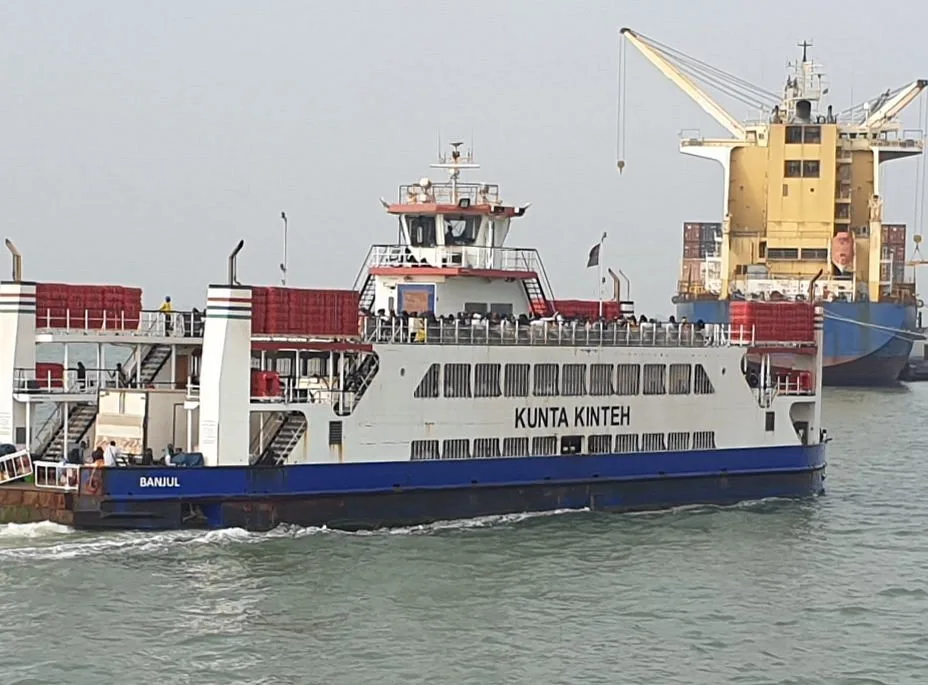
The Banjul-Barra crossing is one of the country’s most important transport links, connecting the capital side of the River Gambia with Barra and the North Bank. It carries passengers, vehicles and goods and is used by commuters as well as travellers continuing toward Senegal or North Bank communities.
The Gambia Ports Authority says Gambia Ferry Services provides cross-river passenger and goods services, with Banjul-Barra among its most prominent routes. In 2026, the fleet gained a new hybrid ferry named Barra, part of efforts to improve capacity and reliability.
Gambia Ferry Services said in an August 23 update that all three ferries were in operation at that time, although Kunta Kinteh operated periodically depending on demand. Ferry availability can change because of maintenance, tides, traffic and mechanical issues, so treat any months-old fleet update as history rather than a promise for the morning you travel.
A digital platform called Taama currently markets e-ticketing for Gambia Ferry Services and says tickets can be purchased for broad morning, afternoon and evening travel periods. Because departure times depend on loading and conditions, passengers should still verify current operations before setting out.
Ferry safety and vehicle travel
UK travel advice is more cautious than the operator’s promotional material. It says the Banjul-Barra service can be overcrowded, warns that safety measures do not meet international standards and recommends considering the Senegambia Bridge as an alternative. It also advises drivers to leave their vehicle after parking on the ferry rather than remaining trapped inside during the crossing.
Those warnings should be taken seriously. On any ferry, follow crew instructions, identify where life-saving equipment is located and keep children supervised. Do not stand in vehicle lanes during loading or unloading.
Gambia Ferry Services’ own public safety notices tell passengers not to lean over railings, not to smoke onboard, to use pedestrian lanes when boarding and disembarking and not to stand between vehicles while the ferry is moving.
Ferry or Senegambia Bridge?
The right choice depends on origin and destination.
If you are moving directly between Banjul and Barra as a foot passenger, the ferry is geographically direct and part of the experience of the capital. If you are driving a longer route and the vehicle queue is heavy, the Senegambia Bridge near Farafenni can be more predictable even though it requires a substantial detour from Banjul.
For journeys between southern and northern parts of the wider Senegambia region, the bridge has transformed road travel by removing dependence on a ferry crossing at that point. It is particularly useful for commercial vehicles and long-distance road trips where schedule reliability matters more than the shortest line on a map.
Before choosing, ask one practical question: “What is the ferry queue like right now?” Current local information can be more valuable than a perfect itinerary prepared two weeks earlier.
Travelling to the North Bank
For destinations such as Barra, Essau, Albreda, Juffureh and other North Bank communities, the Banjul-Barra ferry is often the intuitive route from the capital area. Foot passengers can cross and continue by road transport from Barra.
If visiting historical sites around Juffureh and Kunta Kinteh Island, consider using an organised guide or driver who understands the ferry connection and local boat arrangements. A tour costs more than assembling every leg independently but can prevent a day trip from dissolving into negotiations over the final connection.
Travellers based farther south or east may find the Senegambia Bridge route more logical. Geography in The Gambia is river-shaped: the nearest point in straight-line distance is not always the fastest point by road.
Upcountry travel
The main highway allows road travel deep into the country, including toward Janjanbureh, Bansang and Basse. Long journeys are entirely feasible, but they should be planned like road trips rather than urban taxi rides.
Start early. Carry drinking water. Keep your phone charged and download offline maps. Tell someone your route if travelling independently. Fuel availability is better on main corridors, but do not wait for the tank to reach fumes before looking for a station in a rural area.
Allow time for checkpoints, traffic through towns, livestock, road works and meal stops. Distances that look modest can take longer than expected because average speeds fall once you leave the western urban area.
Rainy-season road travel
June through October requires extra flexibility. Heavy rainfall can cause local flooding, and UK travel advice warns that rural and unpaved routes may become difficult or temporarily impassable.
Do not drive into floodwater simply because another vehicle did. Water can hide potholes, washed-out road edges and drainage channels. If a route is flooded, ask local drivers whether there is a safe alternative and be willing to wait.
For farm visits or village compounds reached by unpaved roads, ask about the last few kilometres before departure. The national highway may be fine while the access road is the section that determines whether the trip is possible.
Pirogues and small boats
Small wooden boats and pirogues operate on waterways around the country, but safety standards vary. UK guidance says they can be overloaded and are not recommended for long journeys. If you use one for a short local transfer or excursion, choose an operator that provides life jackets and do not board an overloaded vessel.
For organised river trips, ask who operates the boat, what safety equipment is carried and what happens if weather deteriorates. “Everyone does it” is not a safety system.
Cycling and walking
Short walks are practical in some tourism areas, but heat, traffic and road design can make distances feel longer than they appear online. Sidewalks are inconsistent, and walking after dark requires extra attention because lighting can be poor.
Cycling can be enjoyable on quiet routes, particularly early in the day, but cyclists must share roads with vehicles, pedestrians and animals. Wear visible clothing and avoid busy roads after dark.
Travelling with children or older relatives
Convenience becomes more important when the group includes young children, older relatives or anyone with mobility limitations. A private transfer may be worth the extra cost if it eliminates multiple vehicle changes or long waits in heat.
For ferry crossings, ask about boarding conditions before committing to a route with someone who has difficulty walking. For upcountry journeys, plan more stops and choose a vehicle with dependable air conditioning if travelling in the hottest months.
Mobile connectivity and navigation
Buy local mobile data early in the trip if your phone is compatible. Maps, messaging and mobile money are useful, but do not depend on constant connectivity. Save addresses, contact numbers and ticket confirmations offline.
If using a ride arranged by WhatsApp, send the vehicle or driver details to someone you trust. For a long private hire, confirm the driver’s phone number and the total price in writing before departure.
Paying for transport
Cash remains important. Carry smaller notes for short taxi and minibus trips rather than expecting every driver to break a large denomination. Mobile-money use is growing, but payment acceptance varies by driver and route.
For a private long-distance hire, clarify whether fuel, tolls, waiting time, ferry charges or overnight driver costs are included. A cheap quote can become expensive when every component turns out to be “separate.”
A simple transport strategy for first-time visitors
For the airport, pre-arrange a hotel transfer or agree a taxi fare before departure.
For short coastal journeys, use taxis and learn the normal local fare from your accommodation or host.
For Banjul to Barra, check ferry operations and queues on the day; consider the Senegambia Bridge for vehicle journeys where reliability matters more than direct distance.
For upcountry trips, leave early, use a mechanically sound vehicle and keep the schedule flexible.
For the rainy season, ask about road conditions near the final destination, not just the main highway.
For night travel, reduce unnecessary long-distance driving and choose a trusted driver when possible.
Final advice
The Gambia rewards travellers who plan the important pieces but leave room for conditions on the ground. Pre-book the airport pickup if arriving late. Confirm a ferry rather than assuming yesterday’s timetable. Agree taxi fares before moving. Start long journeys early. Ask local people about road conditions when it rains.
Transport here is not one system. It is a collection of taxis, shared vehicles, ferries, bridges, private cars, buses and local knowledge stitched together around the River Gambia. Once you understand which option is best for which journey, the country becomes much easier to explore.